
You finally found a cream that seemed to be working. The patches on your cheeks or upper lip started to look a little lighter, and for the first time in a while, you felt hopeful. Then, a few weeks later, the same patches returned, sometimes darker than before. Or maybe they never really faded at all, no matter how religiously you applied the product every single night.
If this cycle sounds painfully familiar, there’s a good chance you’re not dealing with ordinary pigmentation or sun spots. You may be dealing with melasma, a specific, stubborn form of facial pigmentation that behaves very differently from regular dark spots, and one that most generic pigmentation creams simply aren’t designed to handle.
At Sweta Clinics in Kukatpally, melasma is one of the concerns we see the most confusion around. Patients often arrive after months, sometimes years, of trying products meant for sun spots or acne marks, frustrated that nothing seems to hold. The truth is, melasma needs a different, more careful approach altogether, one that treats it as the hormonally-driven condition it actually is, not just another pigmentation problem.
Searching for melasma treatment near me in Kukatpally because your dark patches keep returning? Here’s what’s actually going on with your skin. If you’re still unsure whether you’re dealing with melasma or general facial pigmentation, the American Academy of Dermatology’s melasma overview is a helpful place to cross-check symptoms too.
What Makes Melasma Different From Regular Pigmentation
Most facial pigmentation, sun spots, acne marks, general uneven tone, sits relatively close to the skin’s surface and responds fairly predictably to brightening ingredients and sun protection. Melasma differs in a few important ways.
Hormonal factors primarily drive melasma, which is why it’s so common during pregnancy (sometimes called the “mask of pregnancy”), while on birth control, or during times of hormonal fluctuation. It also tends to sit deeper in the skin than typical sun spots, often affecting both the superficial and deeper layers simultaneously. That’s exactly why it’s notoriously harder to treat and more prone to returning.
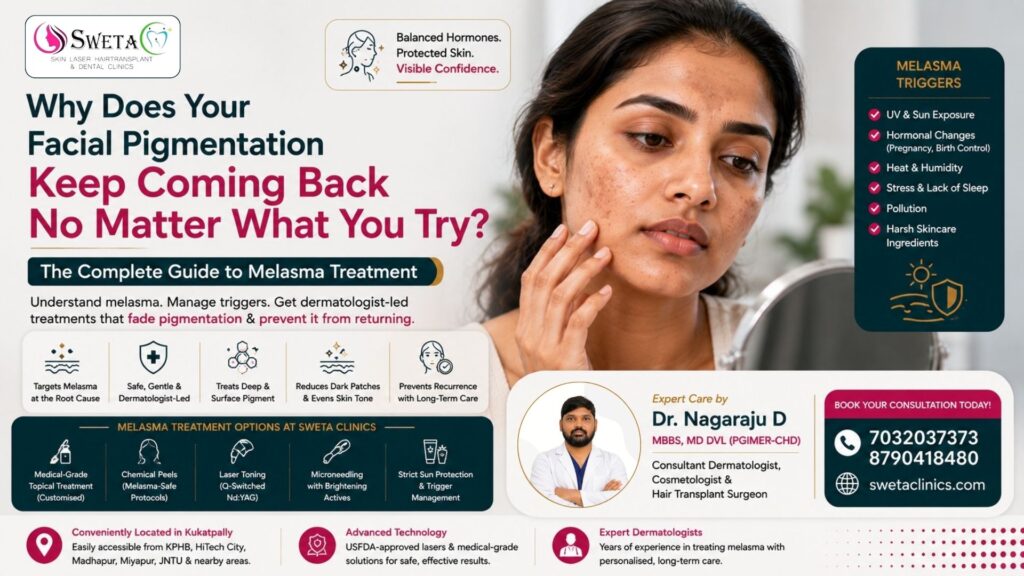
Melasma is also unusually sensitive to triggers. UV exposure, heat, certain skincare ingredients, and even visible light from screens can worsen it or trigger a flare-up. That’s why patients often notice their pigmentation “coming back” even when they thought they were doing everything right.
This combination of hormonal drivers, deeper pigment location, and high sensitivity to triggers is exactly why melasma needs a more specialised, carefully managed approach than standard pigmentation treatment.
Why Generic Pigmentation Products Often Make Melasma Worse
This is one of the most important things to understand about melasma: aggressive treatment can actually backfire. Strong exfoliants, harsh peels, or high-strength brightening actives used without proper guidance can sometimes irritate the skin and trigger post-inflammatory pigmentation on top of the existing melasma, making the overall patch look darker and more widespread rather than better.
This is why melasma treatment isn’t simply “more of the same, but stronger.” It needs a careful, layered approach that treats the pigment gently while protecting the skin from the specific triggers that make melasma flare in the first place.
Recognising Melasma: What It Typically Looks Like
Melasma has a fairly recognisable pattern, which helps distinguish it from other forms of pigmentation:
- Symmetrical patches, usually appearing on both sides of the face in similar locations
- Common areas include the cheeks, forehead, bridge of the nose, upper lip, and chin
- Patches are typically brown or greyish-brown, sometimes with a slightly blotchy or map-like border
- Often worsens with sun exposure, heat, pregnancy, or starting hormonal birth control
- Tends to be more persistent and slower to respond to treatment compared to sun spots or acne marks
If your pigmentation follows this pattern, especially if it flares around hormonal changes or sun exposure, it’s worth getting evaluated specifically for melasma rather than treating it as general pigmentation.
What Happens If Melasma Is Left Untreated or Mismanaged
Melasma doesn’t resolve on its own in most cases, and mismanaging it can make things worse over time.
Patches can deepen and spread, since melasma often expands gradually rather than staying contained without proper trigger management. Wrong treatment can worsen it too, as aggressive, unsupervised treatment can trigger additional pigmentation on top of existing melasma.
Confidence takes a hit as well, since melasma sits on the face and often appears symmetrically, which can feel especially visible and hard to conceal with makeup alone. And many patients cycle through product after product without understanding why nothing seems to hold, which only delays effective treatment further.
The earlier we properly diagnose and manage melasma with the right approach, the more stable and manageable it tends to be long-term.
What a Proper Melasma Diagnosis Looks Like
Effective melasma treatment near me in Kukatpally starts with confirming that what you’re dealing with is actually melasma, and understanding its depth and triggers.
At Sweta Clinics, your first visit typically includes:
- A detailed skin examination, sometimes using specialised lighting, to assess the depth and pattern of pigmentation
- A conversation about hormonal history, including pregnancy, birth control use, and any family history of melasma
- Identifying your specific triggers, including sun exposure habits and any recent product use that may have aggravated the pigmentation
- A personalised, carefully paced treatment plan built around your skin’s tolerance and melasma’s specific behaviour
Melasma Treatment Options at Sweta Clinics
We almost always manage melasma with a layered, longer-term approach rather than a single quick fix.
Medical-Grade Topical Treatment
We select and dose prescription-strength brightening formulations specifically for melasma rather than general pigmentation, gradually reducing pigment production while minimising irritation risk.
Strict Sun Protection Protocol
Because UV and even visible light are major melasma triggers, a rigorous, broad-spectrum sun protection routine isn’t optional add-on advice here, it’s a core part of treatment, without which other steps often fail to hold.
Gentle Chemical Peels
When appropriate, we choose carefully selected, milder chemical peels to help with surface pigment, timing them cautiously in melasma patients to avoid triggering further irritation-related pigmentation.
Low-Downtime Laser Options
Certain laser treatments, used cautiously and at the right settings, can help address stubborn melasma pigment. We approach this carefully, though, since aggressive laser treatment can worsen melasma in some cases.
Ongoing Maintenance Plan
Because melasma tends to be a chronic, trigger-sensitive condition, treatment usually includes a maintenance phase, a lower-intensity routine designed to keep pigment production controlled long after the initial improvement.
Who Should Get Evaluated for Melasma?
You may be dealing with melasma, and should consider a proper evaluation, if:
- You have symmetrical brown or grey-brown patches on your cheeks, forehead, or upper lip
- Your pigmentation worsens noticeably with sun exposure or heat
- Patches appeared or worsened during pregnancy or after starting birth control
- Regular pigmentation creams haven’t helped, or seemed to make things look worse
- You have a family history of melasma or hormonal pigmentation
When Should You See a Dermatologist for Melasma?
As early as possible, ideally as soon as you notice the pattern described above. Melasma tends to respond better to treatment when addressed early and consistently, and delaying treatment while trying random products often makes the eventual treatment process longer and more complicated.
Why Choose Sweta Clinics for Melasma Treatment
Dr. Nagaraju D (MBBS, MD DVL, PGIMER) leads melasma treatment at Sweta Clinics. He brings over 10 years of experience diagnosing and managing melasma and other hormonal pigmentation conditions across Kukatpally and the surrounding areas.
Here’s what makes the difference:
- We never approach melasma the same way as general sun spots or acne marks
- We follow a cautious, layered treatment philosophy designed to avoid the irritation-triggered flare-ups common with aggressive, unsupervised treatment
- We emphasise sun protection and trigger management as a core, non-negotiable part of your plan
- We give you honest, realistic expectations — melasma is a manageable but chronic condition, and we’ll be upfront about what ongoing maintenance looks like
Sweta Clinics is a multi-specialty skin, hair, laser, and dental centre in Kukatpally. Patients reach us easily from KPHB, Miyapur, Nizampet, Pragathi Nagar, Chandanagar, Madhapur, and Hitech City.
Frequently Asked Questions
1. Can melasma be completely cured? We generally consider melasma a manageable, chronic condition rather than something we can permanently cure, since hormonal and UV triggers can cause it to resurface. Consistent maintenance helps keep it well-controlled long-term.
2. How long does melasma treatment take to show results? Melasma responds more slowly than other pigmentation, and visible improvement typically takes 8 to 12 weeks or longer, since treatment must be paced carefully to avoid irritation.
3. Will melasma go away after pregnancy or stopping birth control? For some patients, hormonally-triggered melasma does fade once the hormonal trigger resolves, though many still need active treatment to see meaningful improvement.
4. Is melasma treatment safe during pregnancy? We need to adjust or postpone many melasma treatments during pregnancy, so it’s important to consult your dermatologist about which options suit your specific situation.
5. Can I use regular pigmentation creams for melasma? We don’t recommend this without guidance, since generic products aren’t formulated for melasma’s depth and sensitivity, and can sometimes worsen the pigmentation.
6. Why does my melasma get darker in summer? UV exposure is one of the strongest melasma triggers, which is why consistent, rigorous sun protection is such a critical part of treatment year-round.
7. Where can I find a reliable dermatologist for melasma near Kukatpally? Sweta Clinics in Kukatpally offers dermatologist-led melasma diagnosis and treatment, serving patients across KPHB, Miyapur, Nizampet, and nearby areas.
Book Your Melasma Consultation at Sweta Clinics
You don’t have to keep guessing with products that weren’t designed for what your skin is actually dealing with. Melasma needs a careful, specific approach, and that starts with the right diagnosis.
📞 Call us: 7032037373 / 8790418480 🌐 Visit: swetaclinics.com 📍 Location: Ground Floor, VC Plaza, SBI and Jio building, opposite metro pillar 818 and BJP Office, Vivek Nagar, Kukatpally, HYD, 500072