You’ve read the ingredient lists. Retinol, vitamin C, peptides, the works. You’ve layered serums in the right order and given each one months to work. And yet the pitted marks from old acne are still there. Your skin still feels a little uneven under your fingers. The fine lines around your eyes haven’t budged.
At some point, you’ve probably wondered if creams were ever going to be enough for this. They’re not, and that’s not a failure on your part. Topical products work on the surface. Rebuilding texture, scarring, and firmness happens deeper in the skin, in a layer no cream can reach on its own.
At Sweta Clinics in Kukatpally, this is exactly the gap microneedling is built to close. It’s one of the few treatments that works by triggering your own skin to rebuild itself, rather than just sitting on top of it.
Searching for microneedling treatment near me in Kukatpally because your skin needs more than another serum? Here’s how it actually works, and what it can realistically do for you.
How Microneedling Actually Rebuilds Skin
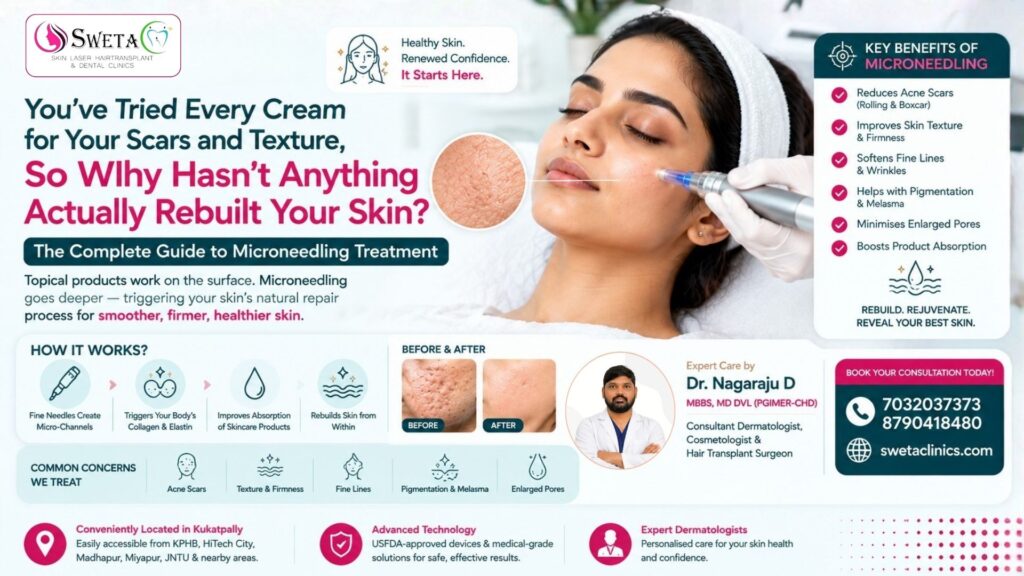
Microneedling, also called collagen induction therapy, uses a device covered in very fine needles to create tiny, controlled punctures in the skin. These micro-injuries are far too small to see individually, but your skin treats them as real damage worth repairing.
That repair process is the whole point. Your body responds by producing fresh collagen and elastin at the site of each puncture. Over the following weeks, that new collagen gradually fills in scar depressions, tightens texture, and improves overall skin firmness. A comprehensive review of clinical studies found microneedling effective across scars, acne, melasma, photodamage, and general skin rejuvenation.
Because the needles create such tiny channels, the outer skin layer stays largely intact. This is exactly why microneedling carries a much shorter recovery time than more aggressive resurfacing procedures, while still producing real, structural change underneath.
Why Microneedling Works Differently From Creams and Serums
Topical products can only do so much, because your skin’s outer layer is designed to keep things out, including the active ingredients you’re applying. Most of what you put on your face never reaches deep enough to influence collagen production directly.
Microneedling sidesteps this barrier entirely. Instead of trying to push ingredients through intact skin, it creates temporary micro-channels that let your skin absorb serums far more effectively right after treatment, while simultaneously kicking off the collagen rebuilding process from within.
This combination, structural stimulation plus better product absorption, is why microneedling often achieves results that months of topical treatment alone can’t match.
What Microneedling Can Actually Treat
Microneedling has grown into one of the more versatile treatments in dermatology, useful for a wide range of concerns:
- Acne scarring, particularly rolling and shallow boxcar scars, where gradually rebuilt collagen fills in the depression from below, a treatment we go into detail on in our acne scar guide
- Overall skin texture and firmness, for skin that feels rougher or looser than it used to, which pairs closely with the goals covered in our skin rejuvenation guide
- Fine lines, especially around the eyes and mouth, where collagen stimulation helps soften early signs of ageing
- Pigmentation and melasma, where improved product absorption can support the results of dedicated pigmentation or melasma treatment plans
- Enlarged pores, since improved collagen support around the pore opening can reduce their visible size over time
What Happens If You Skip Microneedling and Stick to Topicals Only
Nothing goes wrong overnight, but a few things tend to plateau over time.
Scars and texture stay largely unchanged, since topical products don’t reach deep enough to meaningfully rebuild the collagen structure beneath a depression. Your skincare budget also stops delivering full value, because expensive actives partially go to waste when they can’t penetrate past the surface. And for pigmentation-focused routines, you may notice progress slows even when you’re being consistent, simply because absorption is limited without some form of deeper support.
None of this is dangerous, but it does mean waiting longer, and sometimes never fully closing the gap that a course of microneedling could close in months.
The Microneedling Experience at Sweta Clinics
At Sweta Clinics, microneedling always starts with understanding your specific concern and skin condition, not a fixed number of passes applied to everyone.
Initial Skin Consultation
We assess your scarring, texture, or pigmentation concerns first. This determines needle depth, session frequency, and whether we pair microneedling with other treatments like PRP for enhanced results.
The Treatment Session
We apply topical numbing before starting, so most patients feel only mild pressure or a light scratching sensation. A typical session takes 30 to 45 minutes depending on the treatment area.
Recovery and Aftercare
Your skin will look flushed, similar to a mild sunburn, for a day or two after treatment. Most patients return to normal activities the next day, though we recommend avoiding makeup for 24 hours and staying diligent with sunscreen.
Progressive, Cumulative Results
Collagen rebuilding takes time, so results build gradually across a course of sessions rather than appearing after one visit. Most treatment plans involve three to six sessions spaced four to six weeks apart.
How Microneedling Compares to Other Skin Treatments
Patients often ask how microneedling stacks up against chemical peels or carbon laser peel, since Sweta Clinics offers all three.
Chemical peels work through controlled exfoliation, removing damaged surface layers to improve tone and texture. Microneedling works underneath the surface instead, rebuilding collagen structure rather than resurfacing the top layer. The two are often combined for patients dealing with both textural scarring and surface dullness.
Carbon laser peel focuses on oil control and pore refinement using laser-targeted technology. Microneedling takes a broader approach, supporting scarring, firmness, and texture together through collagen stimulation rather than targeting oil production specifically.
Who Should Get Microneedling?
You may be a good candidate for microneedling if:
- You have rolling or shallow boxcar acne scars that haven’t responded to topical treatment
- Your skin texture feels rougher or looser than it used to
- You want to support a pigmentation or melasma treatment plan with better product absorption
- You’re noticing early fine lines and want a preventive, collagen-building approach
- You want visible improvement without the downtime of more aggressive resurfacing procedures
A Word on Safety and Choosing the Right Provider
Not all microneedling is equal, and this matters more than most patients realise. The American Academy of Dermatology has specifically flagged safety concerns around certain radiofrequency microneedling devices when used without proper medical training. Needle depth, device quality, and technique all affect both safety and results, which is exactly why microneedling should be performed by a trained dermatologist rather than at an unsupervised salon.
Why Choose Sweta Clinics for Microneedling
Dr. Nagaraju D (MBBS, MD DVL, PGIMER) oversees microneedling treatment at Sweta Clinics. He brings over 10 years of experience in medical and cosmetic dermatology across Kukatpally and the surrounding areas.
Here’s what makes the difference:
- We assess your specific concern first, so needle depth and session planning match your actual skin, not a generic protocol
- We use medical-grade devices under proper clinical supervision, never salon-grade equipment
- We can combine microneedling with PRP, peels, or other treatments for a more complete result
- We give you honest timelines, since real collagen rebuilding takes a course of sessions, not one visit
Sweta Clinics is a multi-specialty skin, hair, laser, and dental centre in Kukatpally. Patients reach us easily from KPHB, Miyapur, Nizampet, Pragathi Nagar, Chandanagar, Madhapur, and Hitech City.
Frequently Asked Questions
1. Is microneedling painful? We apply topical numbing beforehand, so most patients feel only mild pressure or light scratching rather than pain.
2. How many sessions of microneedling will I need? Most treatment plans involve three to six sessions spaced four to six weeks apart, depending on your specific concern and its severity.
3. How long is recovery after microneedling? Your skin will look flushed for a day or two, similar to mild sunburn. Most patients return to normal activities the next day.
4. Can microneedling help with deep acne scars? It works well for shallow to moderate scars like rolling and boxcar types. Very deep or ice pick scars may need a combination approach with other treatments.
5. Is microneedling safe for all skin tones? Yes, when performed by a trained dermatologist at the right depth for your skin. This is one reason professional supervision matters more than at-home devices.
6. Can I combine microneedling with other treatments? Yes, it’s often paired with PRP or chemical peels as part of a broader treatment plan for scarring, texture, or pigmentation.
7. Where can I get reliable microneedling near Kukatpally? Sweta Clinics in Kukatpally offers dermatologist-led microneedling treatment, serving patients across KPHB, Miyapur, Nizampet, and nearby areas.
Book Your Microneedling Consultation at Sweta Clinics
Creams and serums can only take your skin so far. If scars, texture, or fine lines have plateaued despite your best efforts, microneedling works at the level your routine simply can’t reach.
📞 Call us: 7032037373 / 8790418480 🌐 Visit: swetaclinics.com 📍 Location: Ground Floor, VC Plaza, SBI and Jio building, opposite metro pillar 818 and BJP Office, Vivek Nagar, Kukatpally, HYD, 500072